A practical, step-by-step guide to raising your score in school, competitive, university and IELTS/TOEFL-style English tests
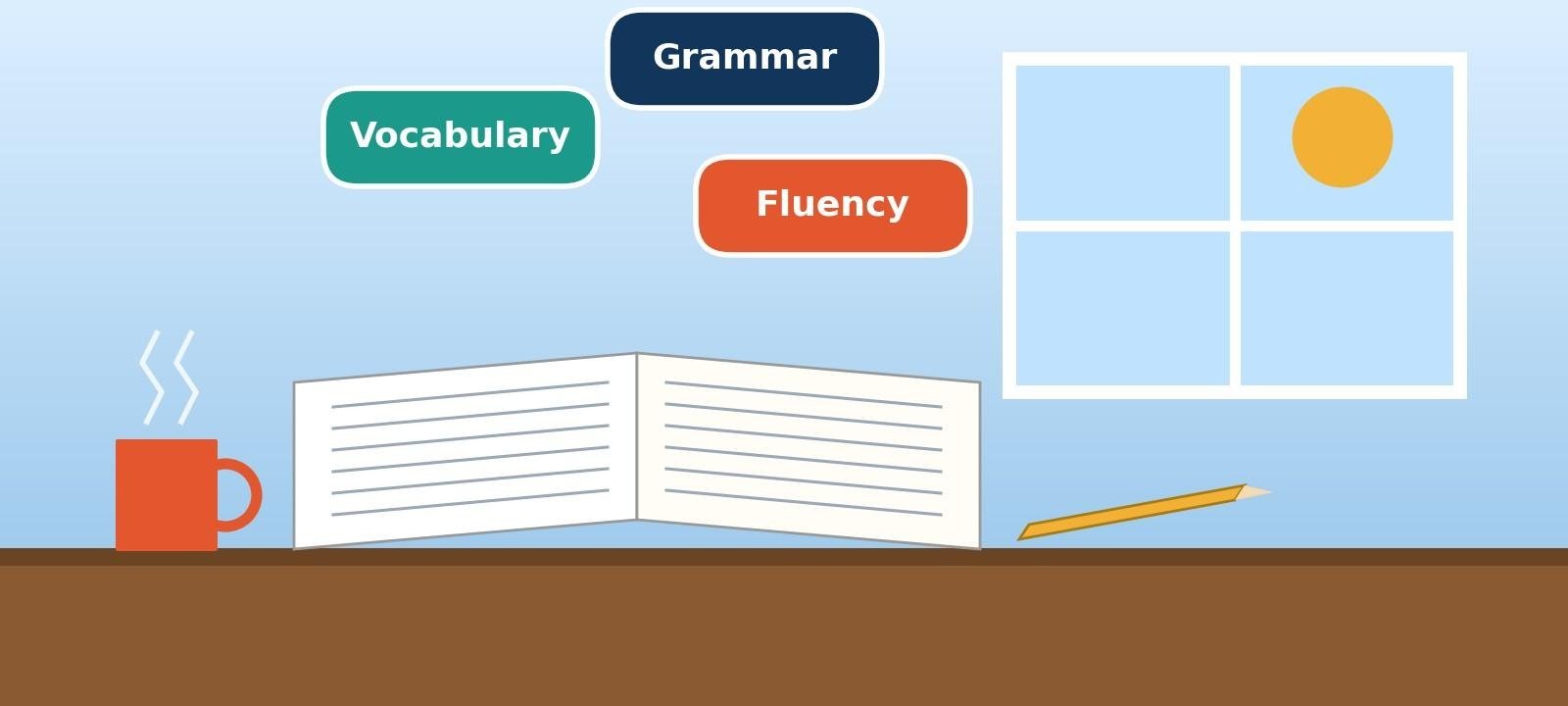
Illustration: the three pillars of exam English – vocabulary, grammar and fluency.
Introduction
How to improve English for exams is a common question among students preparing for school boards, competitive exams, university entrance tests, IELTS, TOEFL, and PTE. The best approach is to build vocabulary, improve grammar, practise reading and writing, and take timed mock tests regularly. English is tested in almost every exam that matters: school boards, bank and government recruitment, university entrance, and international tests such as IELTS, TOEFL and PTE. Many learners believe they need years of study to improve. In reality, a focused plan of 60 to 90 minutes a day, followed for 8 to 12 weeks, produces a clear jump in scores. The secret is not studying more hours but studying the right things in the right way.
This guide explains how to diagnose your level, build vocabulary that stays in memory, fix grammar errors that cost marks, practise all four skills, manage time in the exam hall and follow a realistic weekly routine.
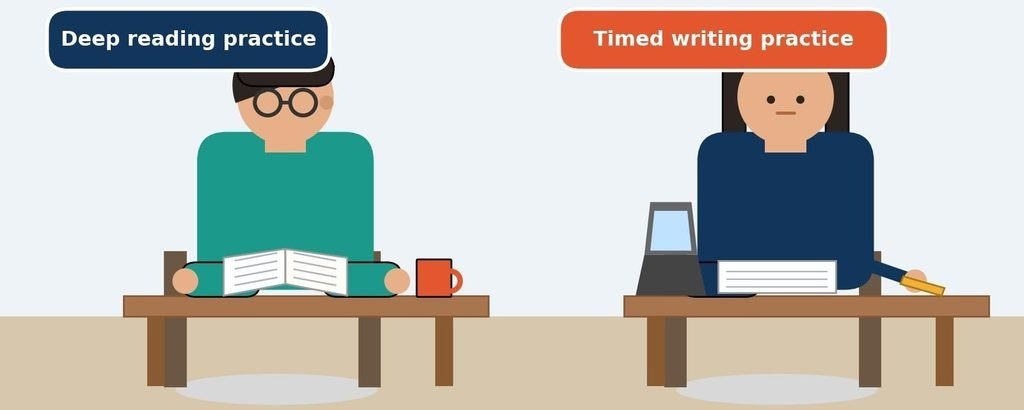
Reading and writing practice are two of the daily habits that build exam-ready English.
Table of Contents
- Start by Finding Your Level
Before you study, take one full-length practice paper under real exam conditions: same time limit, no dictionary, no phone. Then mark it honestly and note where marks were lost. Most students discover that the loss is concentrated in two or three areas, such as reading speed, article and preposition mistakes, or weak essay structure. Fixing these first gives the fastest improvement.
- Record your score for each section (reading, writing, grammar, listening, speaking).
- List your ten most frequent mistakes in a notebook – this becomes your personal error log.
- Set a target score and a date. A goal without a date is only a wish.
- Master the Four Skills Together
Language skills support each other. Reading gives you words, listening trains your ear for natural rhythm, writing forces accuracy and speaking builds confidence. Rotate through all four every week instead of practising only your favourite one.
Figure 1: Rotate through reading, writing, listening and speaking every week.
- Build Vocabulary the Smart Way
Memorising a long list once and never seeing it again is the most common mistake. Research on memory shows that new information fades quickly unless it is revised at increasing intervals. This method is called spaced repetition, and it is the most efficient way to make words permanent.
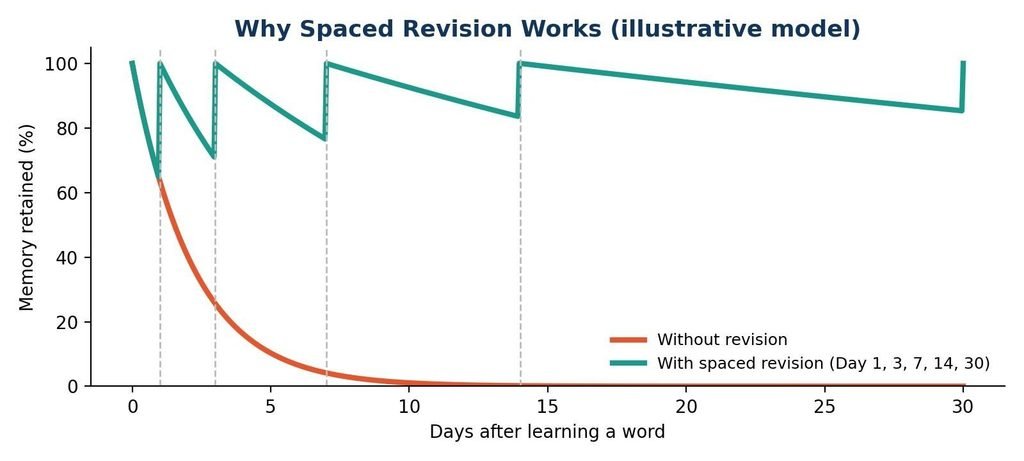
Figure 2: Revising a word on Day 1, 3, 7, 14, and 30 keeps it in long-term memory. The curves are an illustrative model, not exact measurements.
- Learn 8 to 10 words a day, not 50. Write each with its meaning, a sample sentence and its opposite.
- Learn word families: decide, decision, decisive, decisively. One root gives four usable words.
- Use flashcards on paper or in an app, and review the ones you miss more often.
- Learn collocations (words that go together): make a decision, take a risk, heavy rain, strong tea.
- Focus on exam vocabulary: the Academic Word List and common one-word substitutions, synonyms and antonyms.
Pro tip: Say each new word aloud and use it in one sentence about your own life. Personal sentences are remembered far longer than dictionary examples.
- Fix Grammar Errors That Cost Marks
You do not need to master every rule in the grammar book. Exams repeat the same core areas again and again. Concentrate on these and practise them through error-spotting and sentence-correction exercises.
| Area | Common mistake | Correct form |
| Subject-verb agreement | The list of items are ready. | The list of items is ready. |
| Tenses | I am living here since 2020. | I have been living here since 2020. |
| Articles | She is an university student. | She is a university student. |
| Prepositions | He is good in mathematics. | He is good at mathematics. |
| Conditionals | If I will get time, I will call. | If I get time, I will call. |
| Comparatives | This book is more better. | This book is better. |
| Uncountable nouns | Please give me some advice. | Please give me some advice. |
- Reading: Speed and Accuracy
Reading comprehension rewards students who read widely and strategically. Read one editorial or article every day from a newspaper such as The Hindu or The Guardian, and practise summarising it in three sentences. In the exam, use this routine:
- Skim first (30 seconds): read the title, first and last lines of each paragraph to grasp the main idea.
- Read the questions before the passage so you know what to look for.
- Scan for keywords such as names, dates, and numbers, and read around them carefully.
- Guess unknown words from context. Do not stop and panic over one word.
- Beware of extreme words like always, never, all and only. They are often wrong options.
- Writing: Structure Beats Fancy Words
Examiners reward clear organisation, relevant ideas and correct grammar more than complicated vocabulary. Whether you write an essay, letter or report, follow a simple structure:
| Part | What to do | Length (250-word essay) |
| Introduction | Paraphrase the topic and state your position clearly. | 40 words |
| Body paragraph 1 | One main idea, explanation and a specific example. | 90 words |
| Body paragraph 2 | A second idea or opposing view with an example. | 90 words |
| Conclusion | Summarise your view. Add no new ideas. | 30 words |
Write one timed essay or letter every three days. Afterwards, check it against your error log, then rewrite the weakest paragraph. Rewriting teaches more than writing many new pieces.
Pro tip: Use linking words correctly rather than frequently: however, moreover, in contrast, as a result, for instance. One linker per idea is enough.
- Listening and Speaking
Even if your exam has no speaking section, speaking practice sharpens grammar and listening. Try shadowing: play a short clip from a podcast or news bulletin, pause after each sentence and repeat it with the same speed, stress and intonation. Record yourself on your phone and compare. Ten minutes a day is enough to notice a difference in two weeks.
Shadowing with headphones trains your ear and your pronunciation at the same time.
- Listen to BBC Learning English, TED Talks or news podcasts, first with subtitles, then without.
- Practise answering common questions aloud for 60 seconds without stopping. Fluency matters more than perfection.
- Find a study partner or join an online speaking group to practise real conversation.
- Learn to pause and use fillers naturally: Well, let me think… In my opinion…
- A Realistic Weekly Study Plan
Consistency wins. The plan below adds up to roughly 8 to 9 hours per week and covers every skill.
Adjust the timings to your schedule, but do not skip the weekly mock test.
Figure 3: Sample weekly plan in minutes per day. Sunday is reserved for a timed mock test and review.
- Exam Day Strategy
- Divide your time before you begin. Write the time limit for each section on the paper’s margin.
- Attempt easy questions first and mark difficult ones to return to.
- Never leave an answer blank in objective sections unless there is negative marking.
- Reserve the last five minutes to proofread for spelling, tense and punctuation.
- Sleep well and eat lightly the night before. A rested brain reads faster and makes fewer errors.
- Common Mistakes to Avoid
| Mistake | Better approach |
| Memorising long word lists once | Revise in spaced intervals and use words in sentences. |
| Studying grammar rules without practice | Do error-correction exercises daily. |
| Only reading, never writing or speaking. | Rotate all four skills every week. |
| Ignoring mock tests | Take a timed mock every week and analyse your errors. |
| Translating word-for-word from your first language | Learn phrases and think directly in English. |
- 2026 Exam Updates You Should Know
Major English proficiency tests have changed their formats in 2026, so check the current pattern for your target test before you start preparing.
- TOEFL iBT: From 21 January 2026, ETS rolled out a redesigned, adaptive TOEFL that is about 30 minutes shorter than before, with a new 1-6 scoring scale mapped to CEFR levels and faster score reporting.
- PTE Academic: Pearson introduced a shorter roughly two-hour test with new real-life speaking tasks and a combined AI-plus-human scoring process, with results typically available within about 48 hours.
- IELTS: IELTS has kept its core format largely unchanged for 2026, continuing to offer paper-based, computer-delivered and online speaking options, with a gradual push toward more computer-based testing centres.
- Practical takeaway: if you are applying to universities or for immigration, confirm which test version your institution currently accepts, since some destinations were still reviewing the new TOEFL format as of early 2026.
Whichever test you take, the fundamentals in this guide – vocabulary, grammar accuracy, reading speed, and regular speaking and writing practice – remain the deciding factors in your score, format changes aside.
Conclusion
Improving English for exams is a skill-building process, not a talent you either have or lack. Diagnose your level, learn vocabulary with spaced revision, fix your most frequent grammar errors, read and listen daily, write and revise regularly, and practise under timed conditions. Follow the plan for even eight weeks and the difference in your confidence and your score will be visible. Start today with just one page of reading and ten new words.
Pro tip: Your 5-minute start: pick one article, underline five new words, write one sentence with each, and say them aloud. Repeat tomorrow.
Note: The illustrations in this document are original graphics created for this guide.