Class 12 board examinations are critical milestones in a student’s academic pursuits. With an expansive syllabus, numerous subjects, and the mentality to get ‘good marks,’ preparation may seem daunting at first. But the right plan can make the process easier. A sound Class 12 board exam preparation plan doesn’t require you to sit at your table all day; it involves consistent concept-building and practice.
No matter what Stream you are in Science, Commerce, or Humanities– proper planning can help you immensely and can make you land in the exam hall with comfort.
Table of Contents
Understand the Syllabus and Exam Pattern:
Step 1 – For CBSE 12th Board preparation, understand the syllabus. The very first step of your CBSE 12th Board prep will be to comprehend what you are expected to study. Download the new CBSE syllabus for each subject and analyse it by segregating it into chapters and topics. Read all the information about the question paper, question paper pattern, and marking scheme. The students need to practice from the sample papers and previous years’ question papers to understand the pattern of questions asked in the board exams. Students should get help from the sample papers and previous years’ question papers to understand the pattern of questions asked in the board exams.
The pattern of questions in board exams is crucial knowledge for students. They should also understand the question paper pattern, the marking scheme, and the types of questions. Also, students should practice with sample papers and previous year question papers. Identify the weak, average, and strong chapters after going through the syllabus. Using this information, you will be able to devote extra time to those chapters which need to be practised more and not spend the same amount of time on each chapter.
Create a Realistic Study Timetable:
A study schedule can help keep you accountable, but be sure it’s realistic. Instead of trying to study for 10-12 hours a day, break your day into study blocks. Switch back and forth from difficult to simple things throughout the day. For example, study hard in the morning in a subject that is difficult numerically or conceptually, and switch to a theory-heavy subject later on in the day. Make sure to add in small breaks and leave time for revision daily. Also add in question practice, sample papers, and revision of problems in your weekly plan.
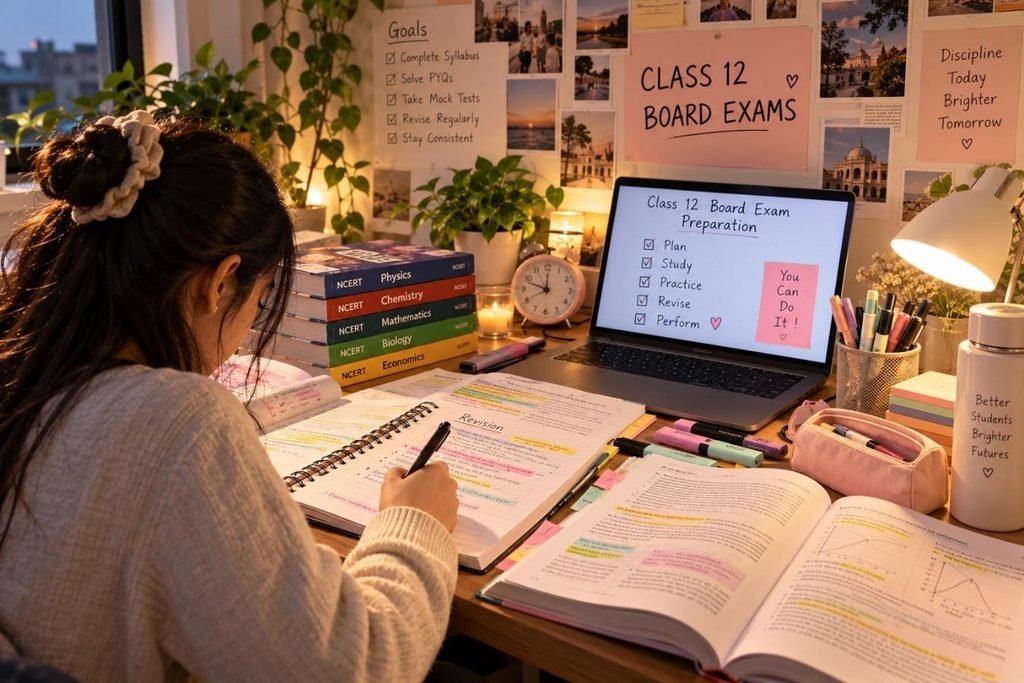
Follow a Stream-Wise Preparation Strategy:
Why a streamlined board study plan? A. It serves well for various topics, as it needs various types of homework for every individual topic.
- Science: Physics, Chemistry & Maths- consistent problem practice is necessary. Biology: Concept Building, diagrams & terminologies– Need to know NCERT from start to end.
- Commerce: Accountancy- numbers must be practised every day. Economics Concepts have to be understood with diagrams, related apps, and numericals. Choose the Correct Course Material & Exam Resources. Business Studies Concepts must be understood, and answers should be written keeping in mind the relevant keywords.
- Humanities: The applicants should stick to the facts, keywords, events, content arguments, examples, and answer pattern, as these humanities are conceptual, and the students should not remember the whole chapter.
Choosing appropriate study resources will help in your success. When preparing for the CBSE exam, learners can refer to the NCERT textbook series in addition to the syllabus and the CBSE textbook series. The NCERT textbooks are designed according to the syllabus and the content as well. For practice, students can take the help of sample papers, marking schemes, previous years’ question papers, and NCERT Exemplar wherever available.
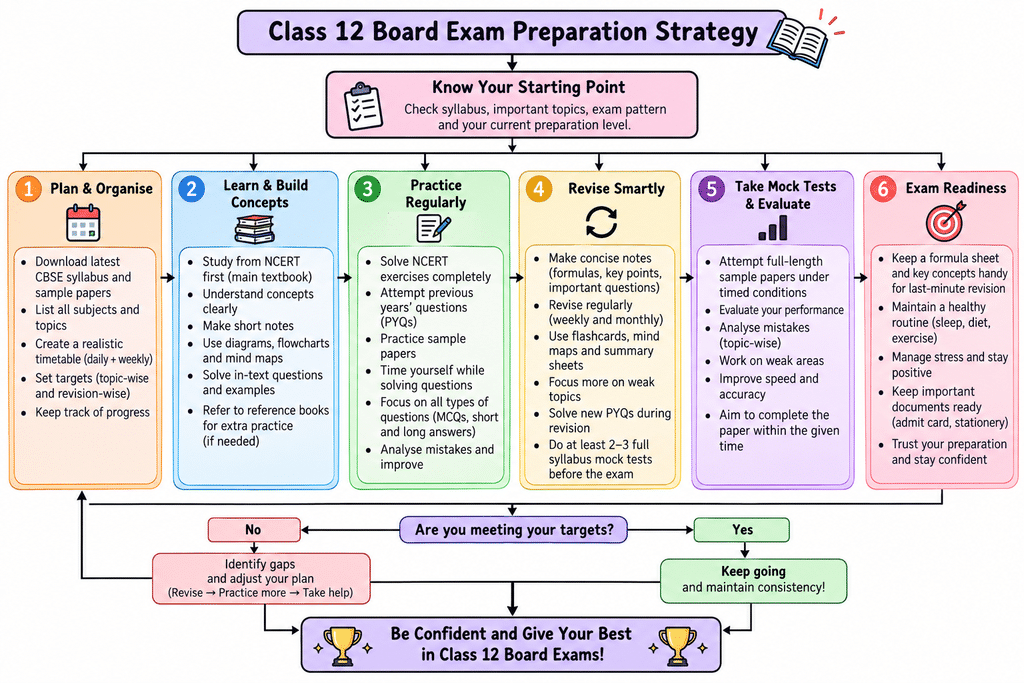
Some useful resources include:
- NCERT textbooks: For concepts, definitions, examples, and basic preparation.
- CBSE sample papers: For becoming familiar with the question paper pattern and solving question papers.
- Previous-year question papers (PYQs): To practice questions at the board level and know the most frequently asked topics.
- NCERT Exemplar: For other conceptual and application-based practice.
- School notes, teacher notes: These are valuable for a quick revision and explanation of the difficult topics.
- Reference books: Useful for more practice after finishing NCERT rather than for substitution.
Don’t overload on resources. It is more effective to use a few solid, reliable resources than 5 or 6 books but not doing much with each one.
Prioritise PYQs in Your Study Schedule:
Previous year questions, also known as PYQs, are a boon when it comes to board prep. They will help students understand the style of questions, get an idea of the important questions, and practise answering in the right manner. Begin solving PYQs chapter-wise once you finish the respective topic. Once the exam nears, move on to solving the complete paper in a time-bound manner. Examine what went wrong and compare your answers with the model answer. What keywords, steps, formulas, diagrams, explanations, etc. are missing? A book of errors can help to stop repetitive mistakes.
But PYQs must not be taken as the blueprint of the questions that are likely to come in the exam. Its sole aim is to help students get accustomed to the pattern of questions and hone application and answer-writing skills.
Follow a Structured Revision Strategy:
Revision needs to start early in the week. A three-stage process can be especially helpful.
First revision: Consolidate concepts, revise notes, and clear doubts.
Second revision: Practice question-solving, PYQs, and application-based questions
Last update: Edit formulas, definitions, diagrams, must-know dates, keywords, and frequently overlooked items.
When you prepare short chapter-wise revision sheets, then it can save you huge hours during your last few days.
Prepare Effectively During the Last Month:
The last month should primarily be for revision and practice exams. Don’t waste precious time of yours writing new notes or watching long lectures on subjects you already know. Attempt full-length mock tests and PYQs in exam mode. Understand your weak points and work hard on those topics.
Keep an even date at the same time. Get good night’s sleep, eat right, and keep relaxed by maintaining your normal meal schedule so that you can remain confident during these very stressful days.
Common Mistakes to Avoid:
Students just choose to do the papers they want; all others are procrastinated. Overstudying and under-practising is the third most Common mistake.
Progress in the syllabus; do not get carried away with completing the syllabus, set little goals in your syllabus, and improve on that. Don’t compare yourself to anyone else and study according to your comfort level.
Stay wary of one-shot videos or dumping. While videos may help make things clearer, active learning through reading, practising, and revision is the way to go for the Boards.
Conclusion:
Let’s understand the right plan to study for the Class 12 board exam. Every subject needs a good study plan, and Class 12 board exam subjects are no exception. A correct preparation plan for the Class 12 board exam is based on regularity, revision, and practice, for which you don’t need to study extra hours. You can get the complete syllabus, get prepared with NCERT, and practice the practice set papers, PYQs & mock tests.
References:
- CBSE – Central Board of Secondary Education
- Official CBSE website for circulars, syllabus, sample question papers, examination information, and academic resources.
- CBSE Official Website
- CBSE Academic – Curriculum & Syllabus
- Useful for checking the latest Class 12 syllabus and curriculum.
- CBSE Academic Website
- CBSE Sample Question Papers
- Official sample papers and marking schemes for Class 12 board preparation.
- CBSE Sample Question Papers
- CBSE Previous Year Question Papers
- Official CBSE question papers that students can use for practice and understanding examination patterns.
- CBSE Previous Year Question Papers NCERT – National Council of Educational Research and Training
- Official source for NCERT textbooks and educational resources, particularly important for CBSE preparation.