
Using a 25 minute study timer is one of the simplest study productivity methods students can use to stay focused and avoid procrastination.
Introduction:
Most of us have done this. You tell yourself you’ll study all evening, you make tea, you open the textbook, and forty minutes later you’ve reorganised your desk and checked your phone about nine times. The hours go by, but you learn little.
I used to think that was a willpower problem. It mostly isn’t. Staying locked in on one thing for long stretches is just hard, and the Pomodoro Technique works because it stops pretending otherwise.
A Tomato Timer and a Struggling Student
The method comes from Francesco Cirillo, an Italian university student in the late 1980s who couldn’t make himself concentrate. He grabbed a kitchen timer shaped like a tomato (pomodoro is Italian for tomato, hence the name) and made a deal with himself: ten minutes of real focus, nothing else. It helped, so he kept tweaking it. What came out of that is the version people use today, a 25-minute study timer followed by a short break.
That’s really all it is. No special equipment, no subscription, no complicated system to learn. As a study productivity method, it’s about as basic as they come, which is probably why people actually keep doing it.
How to Use a 25 Minute Study Timer
The Basic Routine
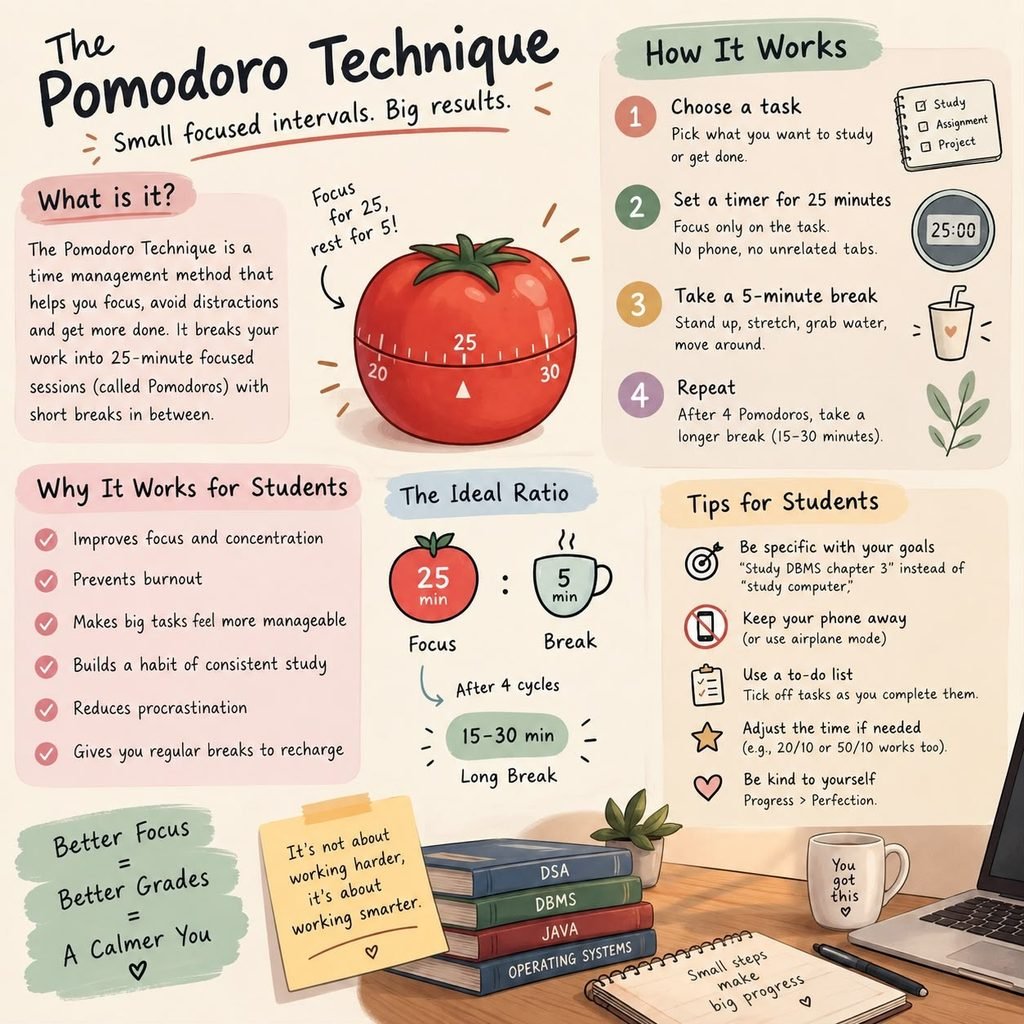
Pick one thing to work on. Maybe a chapter, maybe a set of practice problems. Start the timer for 25 minutes and work on only that. When it goes off, stop and rest for five minutes. Do this four times, then take a longer break, somewhere between 15 and 30 minutes.
One rule matters more than the others: don’t break the 25 minutes. If you suddenly remember you need to email your professor, write it on a sticky note and keep going. It’ll still be there when the timer rings. You’d be surprised how many “urgent” thoughts turn out to be nothing once you’ve waited a few minutes.
Why the Pomodoro Technique is a Powerful Study Productivity Method
Why It Helps
The biggest thing for me was getting started. “Study biology” is a vague, heavy task, and my brain wants to avoid it. “Sit with biology for 25 minutes” is small enough that I can just do it. And once I’ve started, I usually keep going past where I thought I would.
The breaks matter too. Your attention really does wear down, and if you push through without stopping, the last hour of studying is often worth a fraction of the first. Short rests keep your focus from sagging as badly.
There’s also something satisfying about counting. At the end of a day, saying “I did five pomodoros” feels more real than “I studied for a while.” After a couple of weeks, you also learn how long things actually take you. That makes planning for exams much less of a guessing game.
Tips to Stick with the 25 Minute Study Timer
Making It Stick
Some practical things I’ve picked up, or heard from other students:
Put your phone somewhere else. Not face down on the desk, but in another room or at least in a bag. Even seeing it pulls at you.
Use your breaks for actual breaks. Stretch, get water, stare out the window. Scrolling social media feels like resting, but your brain is still taking in information, and five minutes has a way of turning into twenty.
Decide what each session is for before you sit down. If you spend the first five minutes figuring out what to work on, you’ve lost a fifth of your block. Writing a short list the night before takes care of this.
Be realistic about what fits. Flashcards fit neatly into one session. A full essay might take four or five, and that’s completely normal.
It Doesn’t Have to Be Exactly 25
Here’s the part people skip over. Twenty-five minutes isn’t sacred. If you’re doing something that needs a long warm-up, like programming or heavy math, the timer might go off right when you’re finally in the zone. In that case, try 45 minutes on and 10 off. If focusing is a real struggle for you, start with 15-minute blocks and build up.
What matters is the pattern: focused work, then a real pause. The exact numbers are up to you.
It also won’t fix everything. If you’re running on four hours of sleep or you’re overwhelmed, a timer won’t change that. Sleep and basic routines come first, and no study trick replaces them.
Just Try One
You don’t need an app. Your phone’s clock is fine. Pick the subject you’ve been putting off, set a 25-minute study timer, and start. When it rings, take your break and don’t feel guilty about it.
Give it a week and see how it goes. A lot of people find they get more done in four focused sessions than in a whole scattered evening. It won’t make studying fun, but it can make it manageable, and for most of us that’s the difference between meaning to study and actually doing it.
Reference :
[1] “Tells about Cirillo and his techniques to deal with while studying”,[Online]
Available:https://www.pomodorotechnique.com/francesco-cirillo/
[2] “About the standard cycle of 25 minutes of work”,[Online]
Available:https://www.webwork-tracker.com/blog/pomodoro-technique