
Memory retention techniques such as forgetting curve spaced repetition and active recall can transform the way students remember what they study.
Introduction
Have you ever studied for hours, felt like you understood everything, and then forgotten most of it a few days later? It happens to almost every student. The problem is often not how much you study, but how you study.
Simply reading the same chapter again and again may make the information feel familiar, but familiarity does not always mean that you can remember it during an exam. To improve memory retention, students need to use techniques that encourage the brain to actively recall and revisit information. These memory retention techniques, including the forgetting curve spaced repetition, make studying more effective.
This article explains some simple and practical ways to understand how to remember what you study and make your study sessions more effective.
Why Do We Forget What We Study?
Our memory naturally becomes weaker when information is not revisited. This idea is commonly explained through the forgetting curve, which shows how information can be forgotten over time when it is not recalled.
This is why studying a topic once and leaving it untouched for weeks is usually less effective than revisiting it regularly.
The good news is that forgetting can be reduced by using techniques such as spaced repetition and active recall.
1. Use Active Recall
Memory Retention Techniques with Active Recall
Active recall means trying to remember information without looking at your notes.
For example, instead of reading a definition five times, close your book and ask yourself:
“What is this concept?”
Then explain it in your own words.
You can use active recall through:
- Flashcards
- Practice questions
- Short quizzes
- Writing answers from memory
- Explaining a topic aloud
Practice testing and retrieval practice are among the memory retention techniques with strong research support for improving retention.

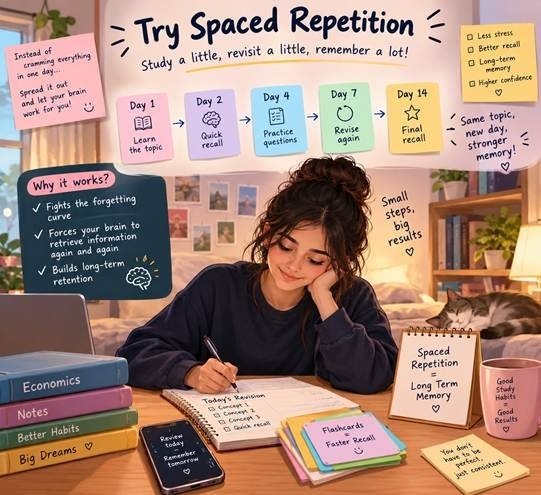
2. Try Spaced Repetition
One of the most useful memory retention techniques is spaced repetition.
Instead of studying the same topic for three hours in one day, revise it for shorter periods over several days.
For example:
- Day 1: Learn the topic
- Day 2: Quick recall
- Day 4: Practice questions
- Day 7: Revise again
- Day 14: Final recall
This approach is connected to distributed practice, which research suggests is more effective for long-term retention than cramming.
3. Understand the Forgetting Curve
The forgetting curve reminds us that memory can decline when we do not revisit information.
For example, you may remember most of a chapter immediately after studying it, but remember much less a week later.
Instead of waiting until you completely forget the topic, revise it at intervals. Every time you try to retrieve the information, you give your memory another opportunity to strengthen it.

4. Explain What You Learn
One of the easiest ways to check whether you actually understand something is to explain it as if you were teaching someone else.
For example, if you are studying economics, don’t just memorize the definition of opportunity cost. Try explaining it using a real-life example, such as choosing to study instead of watching a movie.
If you can explain a difficult concept in simple language, you probably understand it much better.

5. Turn Notes Into Questions
Instead of making long notes, turn important points into questions.
For example:
Notes:
Types of unemployment: frictional, structural and cyclical.
Questions:
- What is frictional unemployment?
- What causes structural unemployment?
- What is cyclical unemployment?
- How are they different?
Later, answer these questions without looking at your notes. This turns your notes into a revision tool.

6. Use Flashcards Effectively
Flashcards are useful for remembering definitions, formulas, dates and important facts.
However, don’t simply read both sides.
Look at the question, pause and try to answer it from memory, and only then check the answer.
The effort of retrieving information is what makes the technique useful.

7. Avoid Last-Minute Cramming
Studying everything the night before an exam may seem productive, but it is not the best strategy for long-term memory.
Try dividing your study time across several days instead.
For example:
1 hour for 5 days is generally more useful for long-term retention than 5 hours on one night.
Regular revision gives your brain multiple opportunities to retrieve the information.

8. Take Care of Your Sleep
Sleep is also an important part of learning. Studying until very late every night can leave you tired and make it harder to concentrate the next day.
A better routine is:
Study → Recall → Revise → Sleep → Recall again later
Good study habits are not only about spending more time with your books. They are also about giving your brain enough time to process what you have learned.
A Simple Study Routine
If you don’t know where to start, follow this five-step method:
1. Learn – Understand the topic.
2. Recall – Close your notes and remember what you studied.
3. Practise – Solve questions without looking at the answers.
4. Space it out – Revisit the topic after a gap.
5. Repeat – Continue testing yourself until the information becomes easier to recall.

Common Mistakes Students Make
Some common habits can make studying less effective:
- Rereading the same chapter repeatedly
- Highlighting almost everything
- Studying only the night before an exam
- Avoiding practice questions
- Making extremely long notes
- Never revising old topics
- Sacrificing sleep to study
Changing even one or two of these habits can make your study sessions more productive.
Conclusion
Remembering what you study is not about having a naturally perfect memory. It is about using the right techniques consistently.
Active recall, spaced repetition, practice testing and regular revision can help you retain information for longer. Instead of asking yourself, “How many times have I read this?”, ask:
“Can I explain this without looking at my notes?”
That small change can make your studying more active, effective and exam-friendly.
The goal is not to study for endless hours. The goal is to make the hours you study count.
FAQs
What are memory retention techniques?
They are study methods like active recall, spaced repetition, and flashcards that help you remember information longer.
How does the forgetting curve spaced repetition work?
It shows how memory declines over time and how revisiting information at intervals strengthens retention.
Why is active recall better than rereading?
Active recall forces your brain to retrieve information, which builds stronger memory connections.
Can spaced repetition replace cramming?
Yes, spaced repetition is far more effective for long‑term memory than last‑minute cramming.
How do flashcards improve memory retention?
Flashcards encourage active recall by making you answer questions before checking the answer.
What role does sleep play in memory retention techniques?
Sleep consolidates learning, making it easier to recall information later.
How often should I revise using spaced repetition?
Review after 1 day, 3 days, 7 days, and 14 days to strengthen memory.
Can explaining concepts improve memory retention?
Yes, teaching or explaining a topic in simple words shows true understanding and reinforces memory.
What mistakes reduce memory retention?
Rereading chapters repeatedly, highlighting too much, and skipping practice questions weaken retention.
How do I build a simple study routine?
Learn → Recall → Practise → Space it out → Repeat. This cycle supports forgetting curve spaced repetition.
References
[1] Dunlosky, J., Rawson, K. A., Marsh, E. J., Nathan, M. J., & Willingham, D. T. (2013). Improving Students’ Learning With Effective Learning Techniques: Promising Directions From Cognitive and Educational Psychology. Psychological Science in the Public Interest, 14(1), 4–58. (sagepub.com in Bing) (bing.com in Bing)
[2] American Psychological Association. Six Research-Tested Ways to Study Better. APA. (apa.org in Bing) (bing.com in Bing)
[3] Cepeda, N. J., Pashler, H., Vul, E., Wixted, J. T., & Rohrer, D. (2006). Distributed Practice in Verbal Recall Tasks: A Review and Quantitative Synthesis. Psychological Bulletin, 132(3), 354–380. doi: 10.1037/0033-2909.132.3.354 (doi.org in Bing) (bing.com in Bing)
[4] Roediger, H. L., & Karpicke, J. D. (2006). Research on test-enhanced learning and retrieval practice. (apa.org in Bing) (bing.com in Bing)