
Introduction
Daily study routine and student timetable template are the foundation of effective academic skills, helping students plan realistic schedules that actually work. Most students don’t struggle because they lack intelligence. They struggle because they lack a system. Cramming the night before an exam feels productive, but decades of cognitive research show it produces weak, short-lived learning [1]. Academic success depends on a handful of learnable skills: planning, focused practice, active recall, and rest. The foundation of all of them is a realistic timetable. This article explains what the best study timetable for students looks like, why it works, and how to build one that fits your own life.
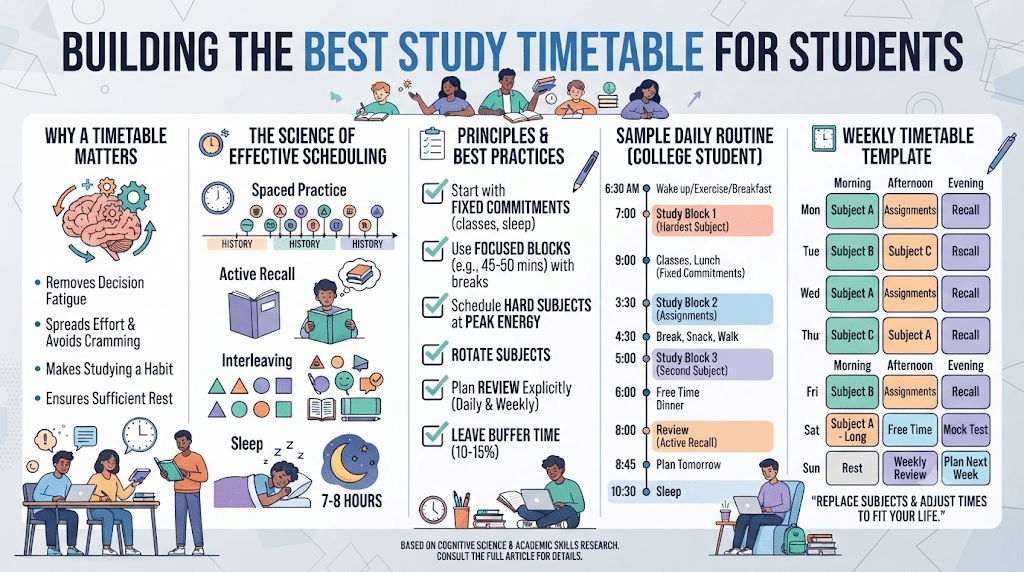
Why a Timetable Matters
A timetable removes the daily decision of “what should I study now?”, which is where most procrastination begins. Research on self-regulated learning shows that students who plan, monitor, and reflect on their study outperform those who study reactively [2]. A good schedule does three things:
- It spreads effort across days, so you aren’t overloaded before deadlines.
- It makes studying a habit rather than a decision.
- It builds in rest, which protects memory and attention.
Searches for a daily study routine and a student timetable template keep growing because students want structure that is simple, visual, and easy to copy. The best study timetable for students is not the most detailed one. It is the one you actually follow.
The Science Behind an Effective Schedule
Spaced practice
Reviewing material over several sessions beats one long session. A large meta-analysis of distributed practice found that spreading study over time significantly improves long-term retention compared to massed study [3]. In practice, studying Economics for 45 minutes on four separate days works better than studying it for three hours once.
Active recall
Testing yourself is more effective than rereading. Roediger and Karpicke showed that students who practiced retrieval remembered far more a week later than students who simply restudied [4]. A review of ten common techniques rated practice testing and distributed practice as the two highest-utility strategies, while highlighting and rereading ranked low [1].
Interleaving
Mixing topics or problem types within a session, rather than blocking one topic, improves later performance, particularly in math-heavy subjects [5]. It feels harder, but that difficulty is what strengthens learning.
Sleep
Sleep loss is consistently associated with reduced learning capacity and poorer academic performance [6]. A timetable that steals sleep to add study hours defeats its own purpose.
Principles of the Best Study Timetable for Students
1. Start with fixed commitments. Mark classes, travel, meals, and sleep first. Study blocks go into what remains, not the other way around.
2. Use focused blocks with breaks. The Pomodoro Technique uses 25 minutes of work followed by a 5-minute break [7]. Many students prefer 45 to 50 minute blocks for deeper subjects. Pick one and stay consistent.
3. Schedule hard subjects at your peak energy. If you think best in the morning, put your toughest subject there and keep lighter tasks like revision or notes for the evening.
4. Rotate subjects. Give each subject a regular slot, and avoid spending a whole day on one course.
5. Plan review explicitly. Reserve a short block each day to revisit yesterday’s material, and a longer weekly block to consolidate.
6. Leave buffer time. Plans fail when they have no slack. Keeping 10 to 15 percent of your week unscheduled absorbs delays.
A Sample Daily Study Routine
This is a flexible daily study routine for a college student with classes in the daytime. Adjust the times to your own schedule.
| Time | Activity | Purpose |
| 6:30 – 7:00 AM | Wake up, light exercise, breakfast | Energy and alertness |
| 7:00 – 8:30 AM | Study block 1: hardest subject (2 × 45 min) | Peak focus |
| 9:00 AM – 3:00 PM | Classes, travel, lunch | Fixed commitments |
| 3:30 – 4:30 PM | Study block 2: assignments or problem sets | Application |
| 4:30 – 5:00 PM | Break, snack, walk | Recovery |
| 5:00 – 6:00 PM | Study block 3: second subject | Rotation |
| 6:00 – 8:00 PM | Free time, dinner, hobbies | Rest and social |
| 8:00 – 8:45 PM | Review: active recall of the day’s material | Retention |
| 8:45 – 9:30 PM | Plan tomorrow, light reading | Preparation |
| 10:30 PM | Sleep (7 to 8 hours) | Memory consolidation |
A Student Timetable Template You Can Cop
Use this weekly student timetable template as a starting point. Replace subject names with your own.
| Mon | Tue | Wed | Thu | Fri | Sat | Sun | |
| Morning block | Subject A | Subject B | Subject A | Subject C | Subject B | Subject A (long) | Rest |
| Afternoon block | Assignments | Subject C | Assignments | Subject A | Assignments | Subject B | Weekly review |
| Evening review | Recall | Recall | Recall | Recall | Recall | Mock test | Plan next week |
How to use it:
- Fill in classes and fixed commitments first.
- Assign each subject two to four weekly slots based on difficulty and upcoming deadlines.
- Keep Saturday for longer, deeper sessions or practice tests.
- Use Sunday for a weekly review and to plan the coming week.
- Revise the template every two weeks based on what actually worked.
Beyond the Timetable: Core Academic Skills
A schedule only creates the time. These skills determine what happens inside it.
- Note-taking: Write in your own words, then convert notes into questions you can use for self-testing.
- Active reading: Preview headings, read in chunks, and summarize each section without looking.
- Goal setting: Give each session a specific outcome, such as “solve five problems on elasticity”, rather than “study economics”.
- Distraction control: Keep your phone out of reach during blocks. Interruptions carry a real cost in refocusing time.
- Reflection: At the end of each week, ask what worked, what didn’t, and what to change. This is the heart of self-regulated learning [2].
Common Mistakes to Avoid
- Overpacking the day with unrealistic hours.
- Skipping breaks and sleep.
- Rereading and highlighting instead of testing yourself [1].
- Copying someone else’s schedule without adapting it to your energy and commitments.
- Abandoning the plan after one missed day. Resume at the next block instead.
Conclusion
The best study timetable for students is simple, realistic, and built on evidence: spaced sessions, active recall, rotated subjects, and enough sleep. Start with a basic daily study routine, adapt a student timetable template to your own classes, and review it every two weeks. Consistency matters more than perfection, and a modest plan followed for months will outperform an ambitious one abandoned in days.
References
[2] B. J. Zimmerman, “Becoming a self-regulated learner: An overview,” Theory Into Practice, vol. 41, no. 2, pp. 64–70, 2002. Available here (tandfonline.com in Bing)
[3] N. J. Cepeda, H. Pashler, E. Vul, J. T. Wixted, and D. Rohrer, “Distributed practice in verbal recall tasks: A review and quantitative synthesis,” Psychological Bulletin, vol. 132, no. 3, pp. 354–380, 2006. Available here (psycnet.apa.org in Bing)
[4] H. L. Roediger III and J. D. Karpicke, “Test-enhanced learning: Taking memory tests improves long-term retention,” Psychological Science, vol. 17, no. 3, pp. 249–255, 2006. Available here (journals.sagepub.com in Bing)
[5] D. Rohrer and K. Taylor, “The shuffling of mathematics problems improves learning,” Instructional Science, vol. 35, no. 6, pp. 481–498, 2007. Available here (link.springer.com in Bing)
[6] G. Curcio, M. Ferrara, and L. De Gennaro, “Sleep loss, learning capacity and academic performance,” Sleep Medicine Reviews, vol. 10, no. 5, pp. 323–337, 2006. Available here (sciencedirect.com in Bing)
[7] F. Cirillo, The Pomodoro Technique: The Life-Changing Time-Management System. London, U.K.: Virgin Books, 2018. Available here (francescocirillo.com in Bing)