
Table of Contents
Introduction
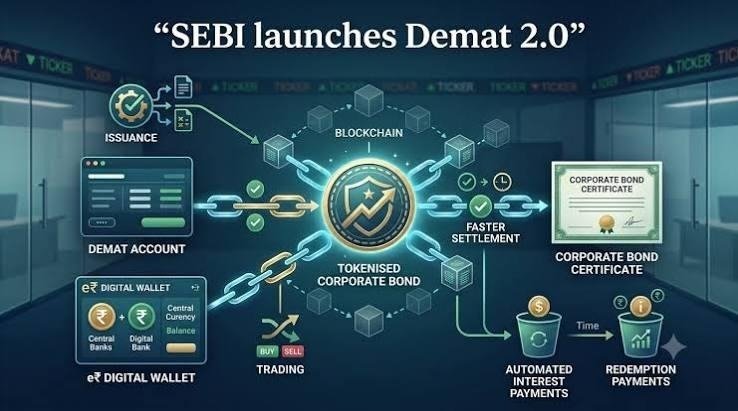
CBDC and tokenisation are emerging technologies that could change how financial institutions issue, hold, transfer, and settle financial assets. India’s Demat 2.0 pilot, announced by the Securities and Exchange Board of India (SEBI) on 10 September 2026, is an important development in this direction. The pilot explores the use of distributed ledger technology (DLT) to issue and hold tokenised corporate bonds, alongside settlement using the Reserve Bank of India’s (RBI) wholesale Central Bank Digital Currency (CBDC).
The initiative brings together digital securities, central bank money, and technology-driven settlement processes. It is designed to test whether these technologies can improve operational efficiency while retaining existing investor protections.
For commerce, accounting, and finance students, understanding CBDC and tokenisation provides useful insight into the future of banking, securities markets, and financial infrastructure.
What Is a Central Bank Digital Currency (CBDC)?
A Central Bank Digital Currency (CBDC) is a digital form of a country’s official currency, issued by its central bank. In India, the CBDC is known as the Digital Rupee or e₹, issued by the Reserve Bank of India.
Unlike privately issued cryptocurrencies such as Bitcoin, a CBDC is a direct liability of the central bank and is denominated in the country’s official currency. India’s Digital Rupee is designed to offer digital payment functionality while retaining the characteristics of central bank money.
Two Categories of India’s Digital Rupee
India’s CBDC programme includes two main categories:
1. Retail CBDC (e₹-R)
Retail CBDC is designed for individuals and businesses. It can be held in digital wallets provided by participating banks and non-bank payment service providers. Users can make person-to-person (P2P) and person-to-merchant (P2M) payments.
The RBI launched the retail CBDC pilot on 1 December 2022.
2. Wholesale CBDC (e₹-W)
Wholesale CBDC is intended for use by banks and other eligible financial institutions. It focuses on financial-market transactions, including the settlement of securities.
The RBI launched the wholesale CBDC pilot on 1 November 2022, initially focusing on the settlement of secondary-market transactions in government securities.
The wholesale segment is particularly relevant to Demat 2.0 because it provides central bank money for settling the funds leg of financial transactions.
What Is Tokenisation in Finance?
Tokenisation in finance refers to representing rights or interests in an asset through digital tokens recorded on a digital system. These tokens can represent financial instruments such as corporate bonds and other securities.
For example, a company issuing corporate bonds may use a tokenised representation of those bonds. The digital tokens can record ownership and relevant transaction information through a distributed ledger.
Distributed Ledger Technology (DLT) allows authorised participants to access a synchronised record of transactions. Depending on the system’s design, this can reduce reconciliation work, improve traceability, and support automated processes.
However, tokenisation does not automatically remove financial or legal risks. A tokenised security remains subject to applicable securities regulations, disclosure requirements, investor protections, and operational safeguards. The technology changes how certain records and processes are handled; it does not automatically change the underlying legal rights of investors.
What Is Demat 2.0?
Demat 2.0 is a SEBI pilot project announced on 10 September 2026 to explore the tokenisation of corporate bonds using distributed ledger technology.
The pilot combines three important elements:
1. Tokenised securities: Corporate bonds are represented digitally through tokens recorded on a permissioned distributed ledger.
2. Wholesale CBDC settlement: The Digital Rupee (e₹-W) is used for the funds leg of the transaction, allowing settlement in central bank money.
3. Technology-enabled processes: DLT-based infrastructure and automated processes can support the recording of ownership and settlement-related activities.
The pilot is being introduced in phases. The initial phase focuses on issuance. Later phases are expected to explore secondary-market trading through existing platforms and participation by retail investors.
At the time of SEBI’s announcement, three companies—REC Limited, L&T Limited, and IIFL—had issued tokenised bonds aggregating ₹1,025 crore.
An important point is that Demat 2.0 does not replace the existing demat system. Tokenised bonds remain the same legal securities, with their existing investor rights and protections. Investors can use their existing demat accounts, subject to enabling the Demat 2.0 facility with their depository and meeting the pilot’s participation requirements.
CBDC and Tokenisation: 7 Ways They Could Transform Financial Markets
1. Faster Securities Settlement
Traditional securities transactions can involve several institutions and processes, including exchanges, clearing corporations, depositories, and banks.
Tokenised securities combined with CBDC settlement could simplify parts of this process. For example, the simultaneous exchange of securities and funds can reduce the risk that one side of a transaction is completed without the other.
This approach is commonly associated with Delivery-versus-Payment (DvP) settlement.
2. Improved Transaction Transparency
Distributed ledgers can maintain a shared record of transactions for authorised participants.
This can make it easier to trace ownership changes and transaction histories. Better access to consistent records may also reduce reconciliation differences between participating institutions.
However, transparency depends on the system’s design, access permissions, and governance arrangements.
3. Reduced Reconciliation Work
Financial transactions often require information to be checked and matched across multiple systems.
A shared ledger can help participating institutions work with synchronised transaction records. This may reduce some manual reconciliation activities and administrative delays.
The actual benefits will depend on how well the technology integrates with existing financial infrastructure.
4. More Automated Financial Processes
Smart contracts are computer programmes that execute predefined instructions when specified conditions are met.
In financial markets, they may support processes such as payment conditions, coupon-related activities, and certain asset-servicing operations.
Automation can reduce manual intervention, but smart contracts still require testing, monitoring, and appropriate legal and operational controls.
5. Settlement in Central Bank Money
Wholesale CBDC enables eligible financial institutions to settle transactions using digital central bank money.
This is important because settlement in central bank money can reduce certain counterparty and settlement risks associated with the movement of funds.
Demat 2.0 explores how this approach can work alongside tokenised corporate bonds.
6. Better Integration of Financial Infrastructure
Tokenisation may support closer integration between securities records, payment systems, and other financial market infrastructure.
If implemented effectively, this could make it easier for institutions to coordinate issuance, ownership records, and settlement activities.
However, interoperability between different platforms and systems remains an important technical and regulatory challenge.
7. New Opportunities for Financial Innovation
The combination of CBDC and tokenisation may create opportunities to modernise financial products and services.
Future applications could include tokenised securities, automated asset servicing, and more efficient settlement arrangements.
The Demat 2.0 pilot will help regulators and market participants evaluate the practical benefits, limitations, and risks before considering wider implementation.
What Should Finance Students Learn About CBDC and Tokenisation?
Finance students should understand more than the basic definitions of digital currencies and blockchain technology. They should also learn how these developments affect financial markets, banking operations, and securities regulation.
Important areas of study include:
- Differences between CBDCs, cryptocurrencies, and commercial bank deposits.
- The distinction between retail CBDC and wholesale CBDC.
- Distributed Ledger Technology and its financial applications.
- Tokenised securities and digital ownership records.
- Smart contracts and automated financial processes.
- Delivery-versus-Payment settlement.
- The roles of the RBI, SEBI, depositories, and participating banks.
- Cybersecurity, privacy, governance, and regulatory compliance.
Students should also understand that technological innovation does not automatically eliminate investment risk. Credit risk, market risk, liquidity risk, and operational risk can still exist even when a security is represented by a digital token.
Conclusion
CBDC and tokenisation are creating new possibilities for India’s financial markets. The Demat 2.0 pilot is an important experiment that combines tokenised corporate bonds with wholesale Digital Rupee settlement.
Rather than replacing traditional demat accounts, the initiative explores how existing securities infrastructure can work with distributed ledger technology and central bank digital money.
For finance and commerce students, these developments offer an opportunity to understand how banking, securities markets, and financial technology are evolving. Following RBI and SEBI updates can help students build practical knowledge of the technologies and regulations shaping the future of finance.
REFERENCES
- Reserve Bank of India. Concept Note on Central Bank Digital Currency. October 2022. RBI website.
- Reserve Bank of India. Digital Rupee (e₹) – Frequently Asked Questions. Updated 1 October 2026. Official RBI FAQs.
- Securities and Exchange Board of India. Successful Launch of “Demat 2.0” Pilot Project for Tokenised Corporate Bonds. Press Release No. 56/2026, 10 September 2026. SEBI press release and FAQ.
- Reserve Bank of India. Operationalisation of Central Bank Digital Currency–Wholesale (e₹-W) Pilot. Press Release, 31 October 2022. RBI press release.
- Reserve Bank of India. Operationalisation of Central Bank Digital Currency–Retail (e₹-R) Pilot. Press Release, 29 November 2022. RBI press release.