
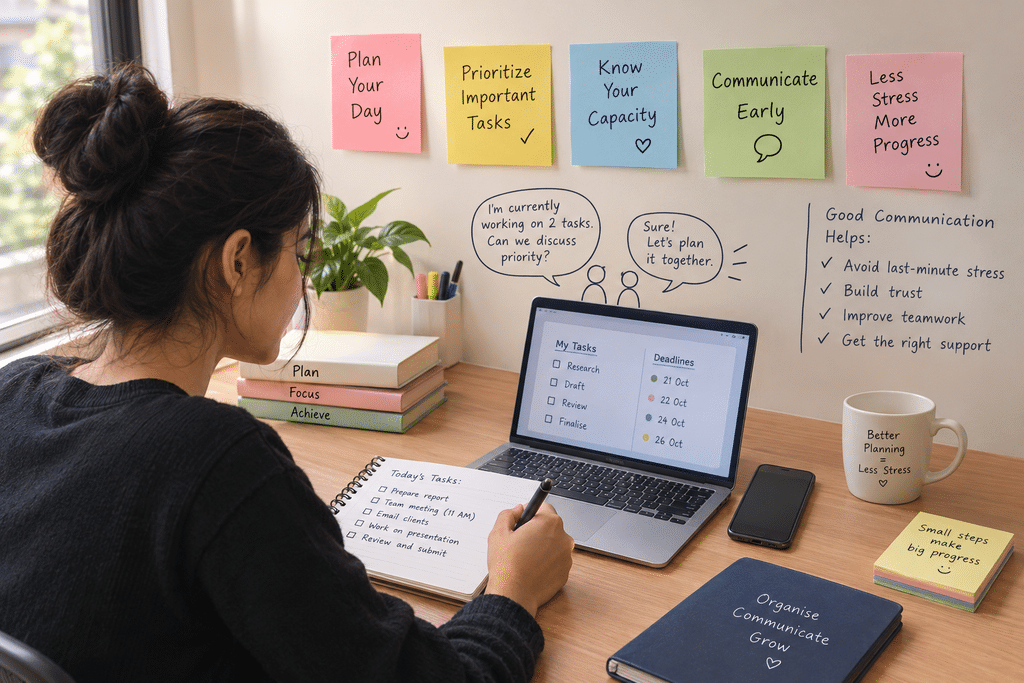
Source : chatgpt
Workload management is an essential skill in today’s fast-moving professional world. Whether someone is working in an office, completing an internship, running a business, or studying in college, managing multiple responsibilities effectively can make it easier to meet deadlines and maintain work quality.
Table of Contents
1. Start Your Day with a Simple Plan
One of the easiest ways to manage workload is to plan your day before starting work. When people have a clear idea of what they need to complete, it becomes easier to stay focused.
Making a simple to-do list can help. Write down all the tasks that need attention and arrange them according to their deadlines and importance. For example, if you have a meeting, a report to prepare, and an email to send, you should first check which task needs immediate attention.
You do not need any complicated planning system. Even a notebook, calendar, or simple mobile reminder can help you keep track of your work.
2. Understand Which Tasks Are More Important
Not every task needs to be completed immediately. Some tasks have strict deadlines, while others can be completed later. Understanding this difference helps people use their time wisely.
A useful way to manage work is to divide tasks into three categories:
- Urgent tasks: Work that needs to be completed as soon as possible.
- Important tasks: Work that contributes to long-term goals and should not be ignored.
- Less important tasks: Work that can be scheduled for another time.
This simple method helps prevent people from spending too much time on small tasks while ignoring more important responsibilities.
3. Understand Your Own Work Capacity
Before accepting new responsibilities, it is important to understand how much work you can actually manage. Every person has a different working speed, schedule, and level of responsibility.
For example, an employee who is already working on two reports and preparing for an important meeting may find it difficult to accept another major task with the same deadline.
Instead of saying yes to everything, take a moment to check your existing workload. Think about how much time the new task will require and whether you can complete it properly.
Understanding your capacity does not mean avoiding work. It means being realistic about what you can deliver within a given time.
4. Communicate Your Workload Early
One of the most important parts of workload management is communication. Sometimes, people know that they have too much work but do not inform their managers or team members.
They wait until the deadline is close, which can create confusion and affect the entire team’s progress.
It is always better to communicate early. If you feel that your workload is becoming difficult to manage, explain the situation to your team leader or manager.
For example, you can say, “I am currently working on two tasks that have deadlines this week. I can also take up the new task, but I may need some extra time. Could you please help me decide which task should be given priority?”
This type of communication is clear, polite, and professional. It also gives the manager an opportunity to adjust deadlines or distribute work among team members.
Clear communication is an important workplace skill that helps employees manage expectations and coordinate responsibilities with their teams.
5. Learn to Say No in a Professional Way
Many people find it difficult to say no when someone gives them additional work. They may worry that refusing a task will create a negative impression or make them look less responsible.
However, accepting more work than you can handle can create bigger problems later. It may result in missed deadlines, incomplete tasks, or poor-quality work.
Instead of directly refusing, you can explain your current responsibilities and suggest another possible time.
For example, you can say, “I would be happy to work on this, but I am currently completing another assignment. Can I start this once I finish my current task?”
This approach shows that you are willing to help while also being honest about your available time.
6. Break Large Tasks into Smaller Steps
Sometimes, a task feels difficult not because it is impossible but because it requires too much time and effort. Looking at the entire task at once can make people feel confused about where to begin.
A better approach is to divide large tasks into smaller steps.
For example, if you have to prepare a detailed report, you can divide it into research, collecting information, writing, editing, and final checking.
Completing one step at a time makes the task easier to manage. It also helps you track your progress and understand how much work is still remaining.
7. Avoid Unnecessary Distractions
Distractions are another common reason why people struggle to complete their work on time. Constant mobile notifications, unnecessary meetings, and switching between different tasks can affect concentration.
Try to give your attention to one task at a time. Keep your phone away when you need to focus and take short breaks between working sessions.
It is also helpful to set a fixed time for checking emails and messages instead of checking them every few minutes.
Small changes in daily habits can make a noticeable difference in productivity.
8. Keep Your Team Updated About Your Progress
Good communication should not happen only when there is a problem. Keeping your team updated about your progress is equally important.
If you have completed a task, inform the concerned person. If you are facing a delay, explain the reason before the deadline passes.
Regular updates help team members understand what is happening and whether any changes are needed. They also reduce misunderstandings and make teamwork smoother.
For example, a simple message such as “I have completed the research part and am currently working on the final draft” can help your manager understand your progress without needing to ask repeatedly.
9. Use Technology to Stay Organised
Technology has made workload management much easier. Today, people can use different digital tools to plan their schedules, set reminders, and track their tasks.
Tools such as Google Calendar, Trello, Notion, and Microsoft To Do can help people organise their daily responsibilities.
These tools allow users to create task lists, set deadlines, and receive reminders. However, using too many tools can also become confusing. It is better to choose one or two tools that match your needs and use them regularly.
10. Maintain a Healthy Balance Between Work and Personal Life
Managing workload is not only about completing professional responsibilities. It is also about giving yourself enough time to rest and manage personal commitments.
Working continuously without taking breaks can affect concentration and make even simple tasks feel difficult. People should try to maintain a routine that includes proper rest, personal time, and time for other responsibilities.
A healthy balance helps people stay focused and maintain their energy throughout the day.
References
[1] World Health Organization, “Mental health at work,” WHO. [Online]. Available: https://www.who.int/news-room/fact-sheets/detail/mental-health-at-work
[2] International Labour Organization, “Psychosocial risks and stress at work,” Nov. 10, 2022. [Online]. Available: https://www.ilo.org/resource/psychosocial-risks-and-stress-work
[3] Health and Safety Executive, “Workload.” [Online]. Available: https://www.hse.gov.uk/humanfactors/topics/workload.htm
Frequently Asked Questions
1. What is workload management?
Workload management is the process of planning, prioritising, distributing, and tracking tasks to complete responsibilities effectively within available time and resources.
2. Why is workload management important?
It helps individuals meet deadlines, maintain work quality, reduce unnecessary pressure, and manage multiple responsibilities more effectively.
3. How can I manage multiple tasks at the same time?
Create a task list, identify priorities, estimate how long each task will take, and work through tasks according to their importance and deadlines.
4. What does communicating work capacity mean?
Communicating work capacity means clearly explaining how much work you can realistically complete within a given timeframe, considering your existing responsibilities.
5. When should I inform my manager about an excessive workload?
Inform your manager as early as possible when you realise that your current responsibilities may affect your ability to meet deadlines or maintain work quality.
6. How can I professionally say no to additional work?
Explain your current commitments, communicate your availability, and suggest an alternative deadline or priority arrangement.
7. Which tools can help with workload management?
Google Calendar, Trello, Notion, and Microsoft To Do can help organise tasks, track deadlines, and manage daily schedules.
8. How can breaking tasks into smaller steps improve productivity?
It makes large assignments easier to approach, helps track progress, and allows individuals to focus on one manageable activity at a time.
9. What is the difference between time management and workload management?
Time management focuses on how available time is used, while workload management considers the amount, priority, distribution, and completion of responsibilities.
10. How can I maintain a healthy work-life balance?
Set realistic work limits, plan personal time, take regular breaks, and avoid consistently accepting more responsibilities than you can manage.