
The Cornell note taking method and mind maps digital notes are two of the most effective strategies students can use to make study notes that truly stick. Knowing how to take effective study notes is one of the most underrated skills a student can build. Most of us were never taught it. We just copy whatever the teacher writes, highlight half the textbook, and hope it sinks in later. It rarely does. Good notes are not a record of everything you heard. They are a tool that helps you understand, remember and revise faster.
Why Your Notes Matter More Than You Think
Notes do two jobs. While you write them, they keep your mind active during a lecture or reading session. Later, they become your main revision material. If your notes are messy or too long, you will spend more time decoding them than learning from them. The goal is simple. Capture ideas, not sentences. Use your own words, and leave space to add more later.
1. Prepare Before You Start
Skim the chapter headings or the lecture slides first. Even five minutes of previewing gives your brain a map to hang new information on. Keep a dedicated notebook or folder for each subject, and always write the date and topic at the top.
2. Try the Cornell Note Taking Method
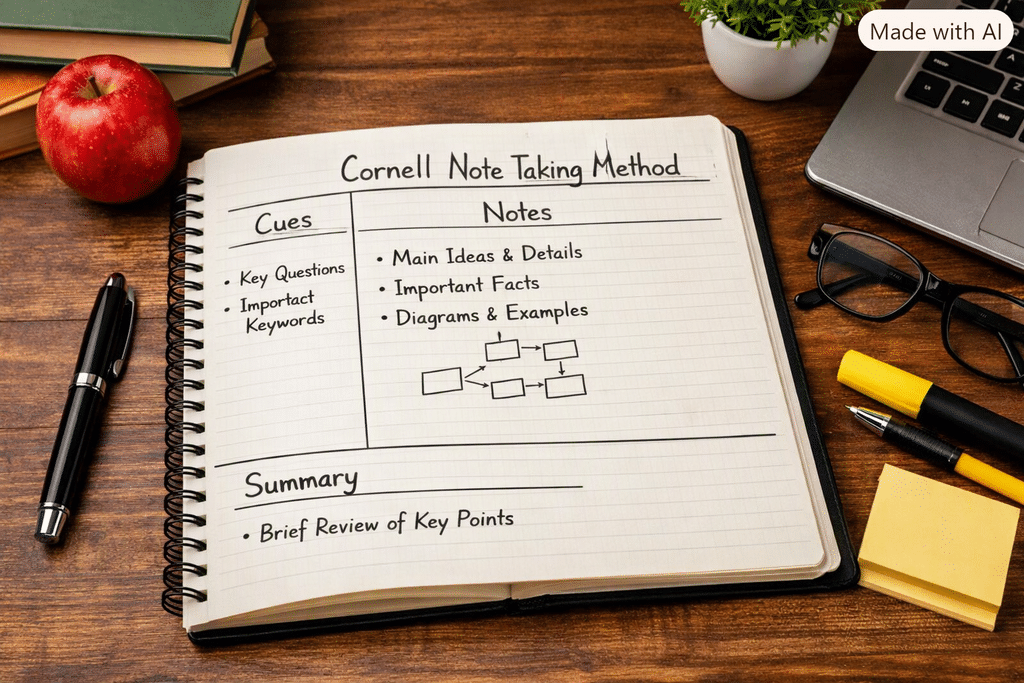
The Cornell note taking method is a favourite for good reason. You divide the page into three parts: a narrow left column for cues, a wide right column for main notes, and a short summary box at the bottom. During class, write your notes in the right column. Afterwards, add keywords or questions in the left column. Finally, summarise the whole page in two or three sentences at the bottom. The magic happens during revision. Cover the right side, read the cues, and test yourself. It turns passive reading into active recall.
3. Use Mind Maps for Big-Picture Topics
Some subjects, like history, biology or business studies, are full of connections. Linear notes can hide those links. A mind map puts the main topic in the centre and branches out into sub-topics, examples and key terms. Use colours and small drawings if they help you. Mind maps work especially well for planning essays and for last-minute revision, because you can see an entire chapter on one page.
4. Go Digital, But Do It Wisely
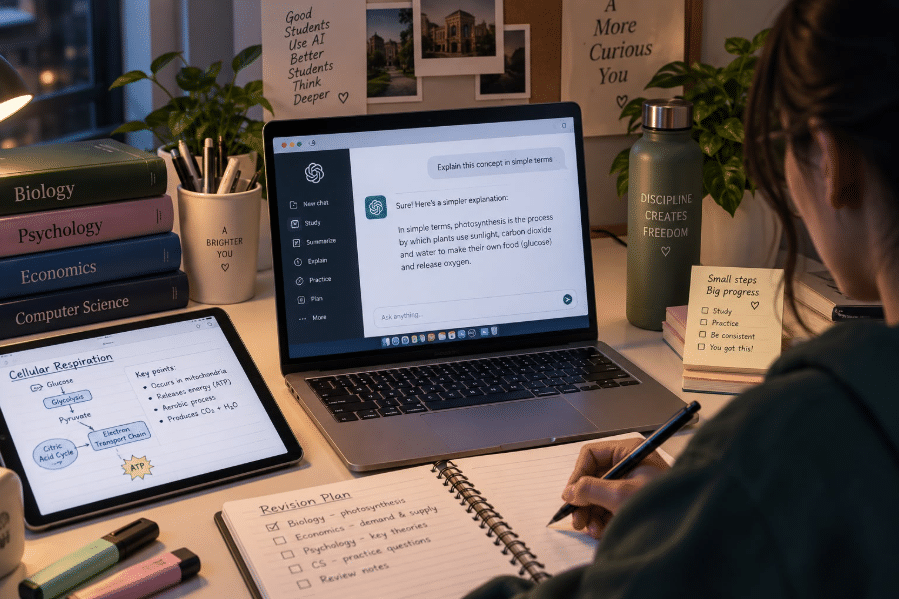
Digital notes are searchable, easy to reorganise and always with you. Apps like OneNote, Notion or Evernote let you tag topics, add images and sync across devices. Many tools also let you build mind maps digitally, which saves paper and makes editing painless. There is one catch. Typing fast makes it tempting to copy everything word for word. Research suggests that students who write by hand often process ideas more deeply and perform better on conceptual questions. If you type, force yourself to paraphrase instead of transcribing.
5. Write Less, Think More
Use short phrases, bullet points and abbreviations you will remember. Underline or star only the truly important points. If everything is highlighted, nothing stands out. A good rule is to ask yourself, “Would I be able to explain this to a friend?” If the answer is no, your note is probably too vague.
6. Review Within 24 Hours
Memory fades quickly. Spend ten minutes the same day cleaning up your notes, filling gaps and adding examples. Then revisit them after a few days and again after a week. This spaced review is far more effective than cramming the night before an exam.
7. Turn Notes Into Questions
Convert headings and key points into questions, then answer them without looking. Flashcards, practice problems and quick self-quizzes all work well. Notes that you test yourself on become knowledge. Notes that you only reread stay as paper.
Common Mistakes to Avoid
- Copying slides word for word
- Writing in long paragraphs
- Never looking at your notes again
- Using one method for every subject
Final Thoughts
There is no single perfect system. Cornell notes may suit a lecture-heavy subject, while a mind map may work better for revision. Experiment for a couple of weeks, keep what works, and drop what does not. Consistent, active note-taking will save you hours and make studying far less stressful.
FAQs
What is the Cornell note taking method?
It’s a structured way of organizing notes into cues, main notes, and a summary, making revision more effective. The Cornell note taking method helps students organize ideas clearly.
How do mind maps help with studying?
Mind maps digital notes show connections between topics, making it easier to understand and remember complex subjects.
Are digital notes better than handwritten notes?
Digital notes are searchable and easy to organize, but handwritten notes often improve memory and conceptual understanding.
How often should students review their notes?
Reviewing within 24 hours, then again after a few days and a week, helps strengthen memory through spaced repetition.
What are common mistakes in note taking?
Copying slides word for word, writing long paragraphs, and never reviewing notes are mistakes that reduce effectiveness.
How does the Cornell note taking method improve memory?
It encourages active recall and summarization, helping students process information instead of just copying it.
Can mind maps digital notes replace traditional notebooks?
Yes, for many students they can — digital mind maps make it easier to reorganize ideas, add visuals, and store notes in one place.
What’s the best app for digital note taking?
Apps like OneNote and Notion support both Cornell note taking method and mind maps digital notes.
How often should I review my study notes?
Review them within 24 hours, then again after a few days and a week. This spaced repetition helps information stick long-term.
What mistakes should I avoid when taking notes?
Avoid copying slides word for word, writing long paragraphs, and skipping regular reviews — these reduce the effectiveness of your notes.
References
[1] W. Pauk and R. J. Q. Owens, How to Study in College, 10th ed. Boston, MA, USA: Wadsworth Cengage Learning, 2010. Available here (cengage.com in Bing)
[2] P. A. Mueller and D. M. Oppenheimer, “The pen is mightier than the keyboard: Advantages of longhand over laptop note taking,” Psychological Science, vol. 25, no. 6, pp. 1159–1168, 2014. doi: 10.1177/0956797614524581 (doi.org in Bing)
[3] T. Buzan and B. Buzan, The Mind Map Book. London, U.K.: BBC Books, 1993. Available here (tonybuzan.com in Bing)
[4] P. Farrand, F. Hussain, and E. Hennessy, “The efficacy of the ‘mind map’ study technique,” Medical Education, vol. 36, no. 5, pp. 426–431, 2002. doi: 10.1046/j.1365-2923.2002.01205.x (doi.org in Bing)