The future of education in India is being shaped by NEP 2020, digital learning initiatives, and the growing use of artificial intelligence (AI) in schools. These developments aim to improve access to education and encourage students to develop critical thinking and practical skills.
Introduced in 2020, the National Education Policy (NEP) is influencing educational reforms and initiatives across India. Digital learning programmes and the adoption of AI in schools are among the developments changing how students learn and teachers deliver lessons.
Examining these initiatives helps us understand how education is evolving in India. However, challenges such as unequal access to technology, reliable internet connectivity, and teacher training must also be addressed.
Implementation of NEP 2020: From Document to Practice
As part of its goals, the National Education Policy 2020 sought to transform India’s rote-learning paradigm into an approach based on critical thinking, adaptability, and competency evaluation. Five years later, the policy’s national assessment organization, PARAKH, is already making strides in revolutionizing the assessment process, steering state examination boards towards assessing understanding over memorization.
At the same time, the policy’s focus on multi-disciplinary education and foundational literacy has played a direct role in how new technologies are being integrated into the classroom, as most AI-related and other digital projects since 2021 have been explicitly guided by NEP 2020.
Table of Contents
The Future of Education in India: Digital University
As part of NEP 2020, the introduction of a Digital University for widespread education was proposed. This initiative also encouraged digital education through PM eVidya, which includes DIKSHA, SWAYAM, dedicated TV, and radio channels.
These resources aim to provide accessible learning opportunities for students across India. PM eVidya supports digital education in schools and higher education, helping build a foundation for a broader digital university model in the future.
Moreover, students in remote areas can benefit from digital learning resources when access to traditional educational facilities is limited.
AI Implementation in Schools in India: The Concrete Figures
AI in India has gone beyond the testing phase in some states of the country. More than 4.5 million AI-based tests have been conducted in Rajasthan alone, and in just 10 days, 2.6 million students were able to complete this reading test with the help of AI technology. Moreover, technology in Gujarat has already been adopted in 1.15 million schools in association with 54000 schools. Uttar Pradesh stands out for having included more schools under the PM SHRI programme than any other state – 1713. As for Chhattisgarh, robotics and AI have been introduced in 800 schools, benefiting more than 40000 students.
At the same time, the national government has taken steps toward implementing the programme across the country, with NCERT recently announcing the adoption of the AI curriculum for the 11th and 12th grades, with the plan to include AI teaching in all educational institutions starting the next academic year. The collaboration of Google and UNICEF is only one example of international cooperation aimed at similar AI literacy initiatives in Indian schools.
What Else Must Be Done
This uneven distribution continues despite all of these developments. The state of Gujarat, as well as Rajasthan and Uttar Pradesh, exhibit much higher levels of adoption when it comes to AI and digital solutions compared to others; and schools that don’t have stable access to electricity and internet are at risk of falling behind instead of moving forward due to these efforts. Training of teachers falls far behind the technological advancement in many cases, which means that hardware and curriculum changes alone won’t help in solving the problem.
Conclusion
Now, the future of education in India is not some far-off goal because it is being realized through NEP 2020, the formation of digital universities through PM eVidya, and the introduction of AI in Indian schools on a massive scale, reaching the tens of lakhs in different states. The true challenge lies in seeing to it that these developments reach all states and all schools in the same way as they have reached the pioneers of the lot.
Key Takeaways
NEP 2020 aims to promote competency-based learning and multidisciplinary education.
Digital initiatives such as DIKSHA, SWAYAM, and PM e-Vidya support access to learning resources.
AI-based learning and assessment initiatives are being explored in Indian schools.
Unequal internet access and infrastructure can limit the benefits of digital education.
Teacher training and responsible AI use are essential for sustainable progress.
References
[1] Organiser, “The NEP 2020 Effect: 14 AI Initiatives Redefining How India Learns,” [Online]. Available: https://organiser.org/2026/07/12/369461/bharat/how-nep-2020-is-building-future-ready-schools-through-14-ai-initiatives/.
[2] AddWeb Solution, “AI in Indian EdTech: How Education Is Changing in 2026–27,” [Online]. Available: https://www.addwebsolution.com/blog/ai-changing-edtech-platforms-india-2026-27.
[3] Convergence Now, “India to Integrate AI into School and College Learning by Next Academic Year, Government Says,” [Online]. Available: https://www.convergence-now.com/artificial-intelligence/india-ai-education-curriculum-2026/.
[4] UDTE School, “AI in Education 2026: Powerful NEP, PARAKH Assessment Shift,” [Online]. Available: https://udteschool.com/ai-in-education-2026-nep-parakh-assessment-reform/.
[5] Press Information Bureau, “PM e-Vidya Empowering Every Learner, Everywhere,” [Online]. Available: https://static.pib.gov.in/WriteReadData/specificdocs/documents/2026/mar/doc2026310818501.pdf.
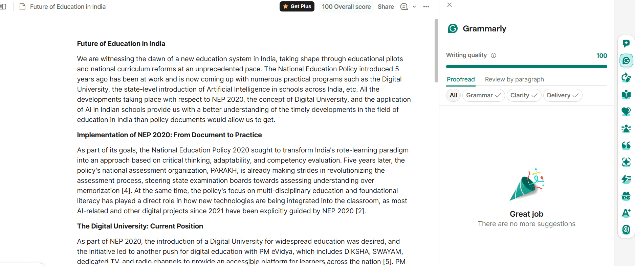
1. Proofreading Report
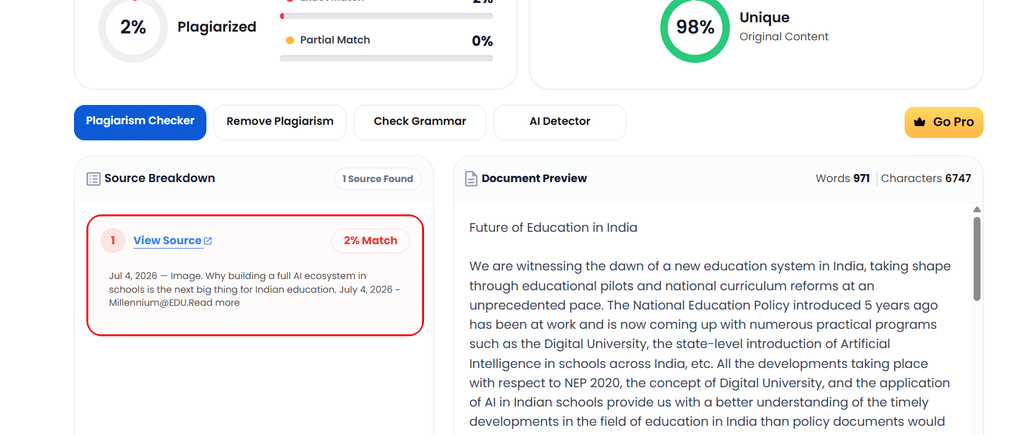
2. Plagiarism Report
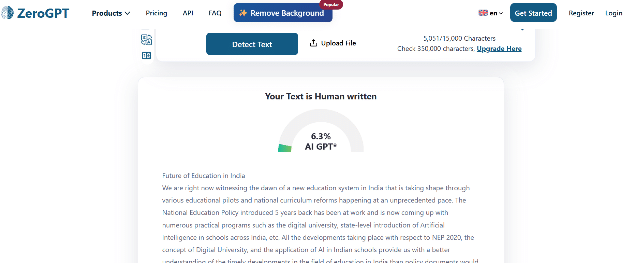
3. AI Detection Report